

Hospital safety ratings: Can the US adopt the NHS' system of care.

The UK's NHS will rate trusts on how well they address misconduct against staff, but what can the US learn from this?


The UK's National Health Service (NHS) recently announced new hospital safety ratings. These ratings evaluate its health systems on operational outcomes, staff wellbeing, workplace violence, racism, and psychological safety. It's an important shift in how we think about healthcare performance. For years, workplace culture has often been treated as a “soft” issue, secondary to the metrics we traditionally use to define a successful hospital.
But that’s about to change.
The question, however, is: what can we across the pond learn from this?
The history of racism and violence against physicians
Healthcare workers shouldn’t have to choose between their passion for healing and their own safety.
But this problem didn't spring up overnight. It's connected to a much deeper history of systemic discrimination that has shaped our healthcare institutions. The American Medical Association openly acknowledged this in its report. In Reckoning with Medicine’s History of racism, it documents its foundations in exclusionary practices against Black physicians.
This historical disregard mirrors the violence we see against our own nurses even today. The U.S. Bureau of Labor Statistics reported that registered nurses experienced higher rates of violence, overexertion, and exposure to harm than almost any other occupation.
That’s not just a coincidence.
It’s a sign that we need to look more closely at the systems supporting the people who provide our care. If we want a healthier healthcare system, we need to start by asking how we can better protect and support the people inside it.
What it takes to implement hospital safety ratings in the US
Unlike the UK tax-funded healthcare system, American hospitals operate primarily as private corporations.
This may slow the voluntary adoption of a hospital safety rating and could result in inconsistent approaches across organizations. But it's not impossible. Real change comes when organizations that work with hospitals make physician and staff wellbeing a meaningful part of the conversation.
Take federal initiatives like the CDC and NIOSH Impact Wellbeing campaign. Programs like this provide an important foundation, but we should ask whether voluntary participation is enough to drive lasting change.
Building on this foundation, federal agencies like the Centers for Medicare & Medicaid Services (CMS), which provides healthcare coverage to over 160 million people (nearly 1 in 2 Americans), could explore ways to incorporate staff safety and wellbeing into its partnerships and quality frameworks.
The shift from voluntary to mandatory: The Joint Commission’s Goal 12
Federal frameworks offer guidance, but the most immediate enforcement mechanisms lie with healthcare accreditation bodies. Why? Because in order to get accreditation and validation of your establishment, you have to play by their rules, and we’re seeing those rules in action.
The Joint Commission’s National Patient Safety Goal 12 (NPG12) places healthcare staff at the vanguard of patient safety and outcomes.
It requires hospitals to ensure their staff have the qualifications and experience needed to provide safe, high-quality patient care. This is also a foundation of hospital reimbursement, linking workforce qualifications to payment and helping keep incentives aligned with quality of care.
At the surface, it sounds like quality control for the sake of patients, but it’s a fundamental victory for workplace safety. When you have qualified, safe staff leading teams, handling equipment, and organizing care, that’ll ensure that staff aren’t mismanaged, disorganized or overexerted to overcompensate for a colleague’s incompetence.
By making staff hire quality part of their requirements, The Joint Commission moves workplace protection beyond a ‘soft’ HR issue to an operational baseline - in line with what we’re seeing with the NHS’ hospital safety ratings.
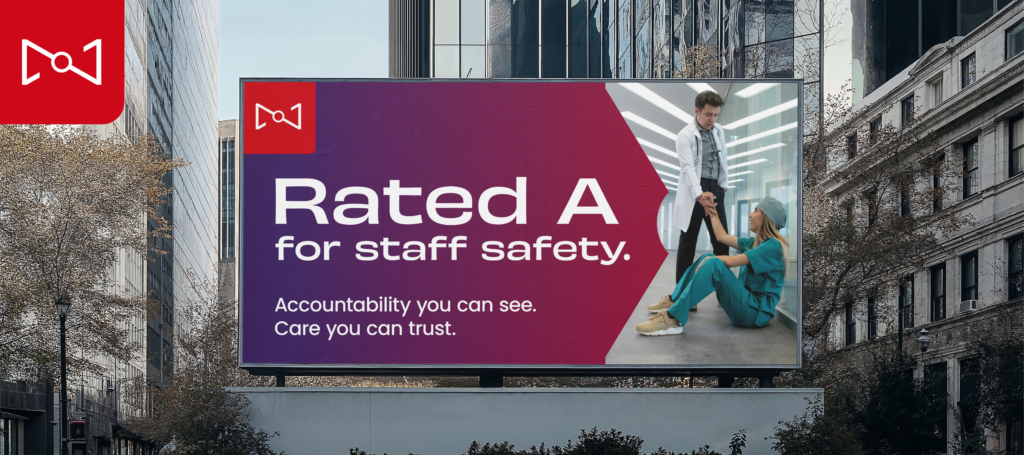
The power of public transparency: should hospital safety ratings be publicised?
Introducing internal standards is only half the battle.
Transparency can be a powerful next step. Just as public ratings for films let us know whether it's worth our dollar, I think bringing in ratings that measure how well a hospital treats its physicians and publicizing this will ensure that hospitals do what they say they will. It'll hold the system accountable.
Public transparency could make staff safety a part of a hospital's broader reputation and accountability. In fact, hospitals that actively put in the work should be recognized for it, creating an incentive for others to follow.
The NHS has taken an important step toward recognizing staff safety as an operational baseline, not an optional benefit.
If our healthcare leaders, CMS, and accrediting bodies want a healthcare workforce that can survive and thrive, then it's time to shift from voluntary wellness initiatives toward stronger accountability.
Because when we take care of the people who deliver healthcare, we strengthen the healthcare system for everyone.
Get insights like this delivered monthly.
Subscribe to the CancerGeek newsletter for exclusive perspectives on healthcare innovation, digital health trends, and more delivered straight to your inbox.