

The 2026 Marketing Talent AI Report: Why Marketing is moving From Task-Based to Purpose-Driven.

The release of the 2026 Marketing Talent AI report confirms what many of us already feel.


Marketing is about to change in ways we’ve never experienced before.
As a member of the Marketing AI Industry Council, I’ve had a front row seat to the conversations shaping this report. My biggest takeaway?
This isn’t incremental change. It’s structural change.
AI in marketing isn’t just automating tasks. It’s reshaping how teams think, operate, and define value. We are moving from task-based marketing to purpose-based marketing, and that shift will redefine talent, workflows, and leadership for the next decade.
Marketing is No Longer About Tasks. It’s About the Game.

For years, marketing teams were built around outputs: Create the campaign. Write the copy. Launch the ad. Send the email.
AI now handles many of those tasks faster and at scale. Tools powered by large language models, like those developed by OpenAI, are accelerating production across all industries.
So the question becomes: If machines can execute the tasks, what is marketing’s true purpose?
The answer is strategy.
Marketing leaders must ask, “What game are we trying to play?”
- What are the rules of the market?
- Are we playing for steady growth or bold disruption?
- Where do we differentiate?
- How can AI give us leverage?
Technology isn’t the strategy, but it now becomes the amplifier of the strategy.
Four Priorities for Marketing Leaders in the AI Era
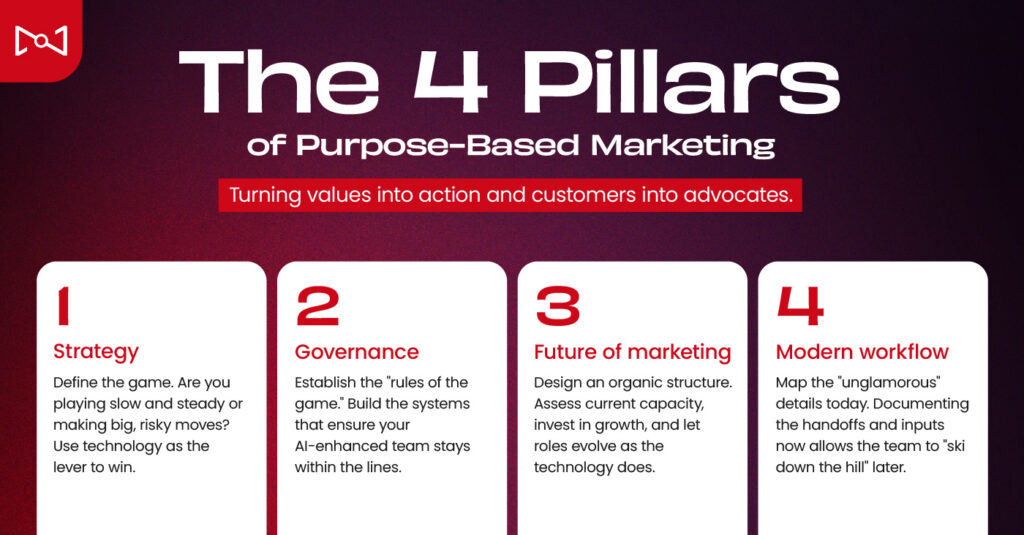
The 2026 Marketing Talent AI Report makes it clear that success in AI-driven marketing requires focus in four critical areas.
Strategy: Define the game before you play it
AI will not fix unclear positioning or weak differentiation. Before implementing tools, leaders must define:
- The competitive game being played
- The pace and risk tolerance of the organization
- Where AI creates unfair advantage
As Harvard Business Review has consistently emphasized, technology without strategic clarity accelerates mediocrity.
A great strategy begins with clarity. Without it, AI simply creates confusion.
Governance: Establish the rules of engagement
As teams adapt AI tools, governance becomes essential. How will AI be used? What guardrails protect brand integrity? How do you ensure compliance, transparency, and ethical use?Governance is not bureaucracy—it’s enablement. It ensures teams can innovate confidently without breaking trust or stepping outside the rules of the game.
Organizations that skip governance will move fast, but pay for it later.
Future of Marketing Talent: Evolve or be replaced
The report highlights a hard truth: marketing roles will change.
Some roles will disappear, some will transform, but new roles will emerge. The question isn’t whether your organization will change. It’s whether you’re designing for change intentionally.
Research from the World Economic Forum suggests AI will both displace and create millions of roles globally, but those who adapt will thrive.
Marketing leaders must:
- Assess current capabilities
- Identify future skill gaps
- Invest in AI fluency and strategic thinking
- Build an organizational structure that is living and adaptive
Let me emphasize this: this isn’t about replacing marketers with AI. It’s about elevating marketers who understand how to work with AI.
Workflow, workflow, workflow.
Workflows are the “sexy” work no one ever sees or takes the time to invest in, but it is the most important.
Before layering AI into your team, you must understand how your team actually works.
- What are the current steps?
- Where are the handoffs?
- Where is the time lost?
- What inputs create outputs?
- Where does content move next?
Mapping workflow is tedious. It requires discipline and patience. But once you climb that hill, once the process is documented and friction is identified, you unlock speed, scalability, and intelligent automation.
You can’t ski downhill until you’ve mapped out the mountain!
From Output to Impact
The 2026 Marketing Talent AI Report confirms what many leaders are already sensing: the future of marketing isn’t about producing more. It’s about producing with purpose.
As AI handles more of the mechanical work, the real advantage moves to clarity of strategy, strong governance, evolving talent, and disciplined workflow design.
The game is changing, and the question is whether your team is built to win it.
Download the 2026 Marketing Talent AI Report here.
Get insights like this delivered monthly.
Subscribe to the CancerGeek newsletter for exclusive perspectives on healthcare innovation, digital health trends, and more delivered straight to your inbox.